Menu
How to Spot Concrete Retaining Wall Failures in Midland
Concrete Retaining Wall Midland
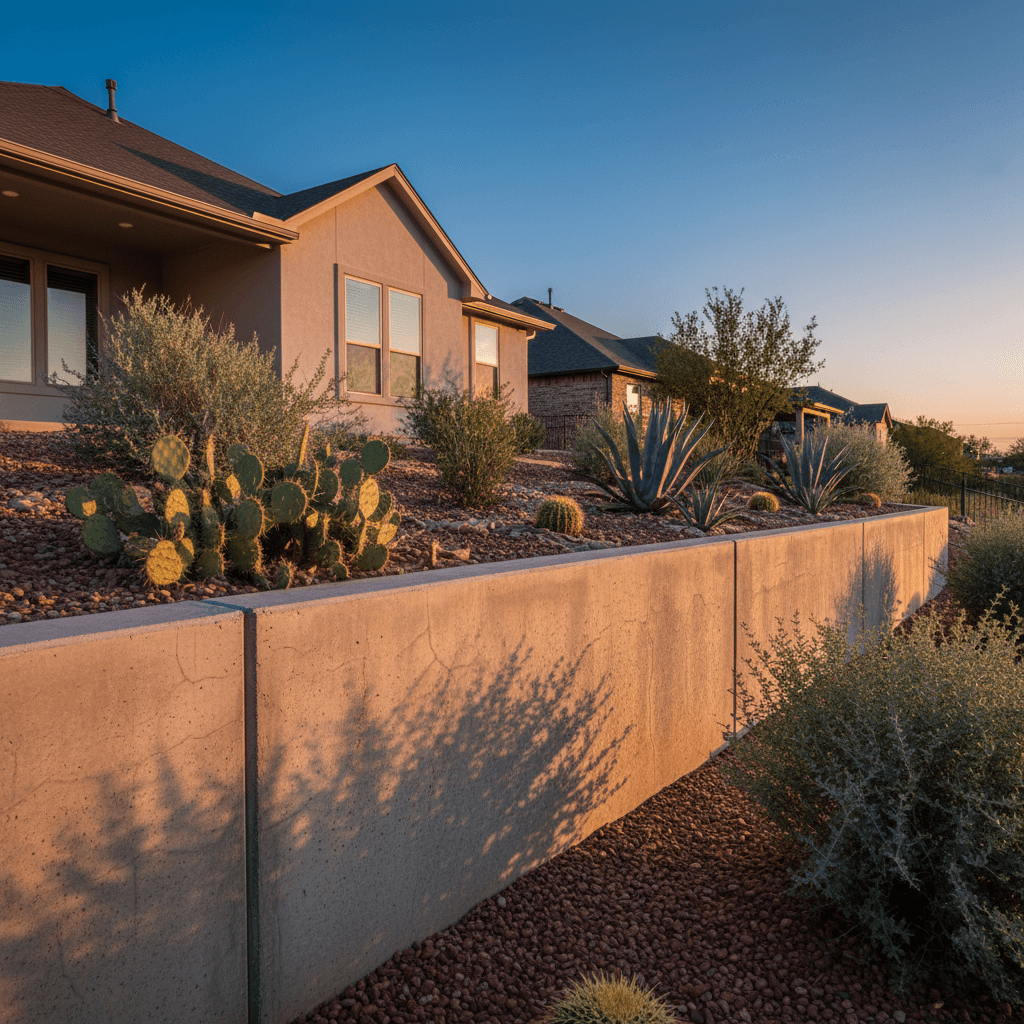
Identifying early warning signs of concrete retaining wall failures protects your Midland property from costly damage and potential safety hazards. West Texas soil conditions and weather patterns create unique challenges for retaining walls that require vigilant monitoring and prompt attention when problems arise. We at Midland Concrete Services help homeowners recognize these critical warning signs before minor issues become major structural failures. Professional evaluation becomes essential when walls show signs of distress, as temporary fixes often mask underlying problems that worsen over time. Understanding what to look for empowers property owners to take proactive measures that preserve both safety and property values throughout the Permian Basin region.
Beware of Structural Movement Warning Signs
Structural movement in your concrete retaining wall is easily identified by visual signs such as leaning, tilting, or bowing of the wall. This type of movement is usually gradual, occurring over months or years as soil pressure exceeds the wall’s designed capacity or the wall’s foundational support fails. When inspecting your wall from different angles, you will notice slight changes in its alignment that may not have been apparent by looking at it from one angle alone. By measuring your wall’s position to stationary reference points, such as other structures or the boundary of your land, you can document any changes over time and show the degree of movement that has occurred.
Types of Structural Movement
When your concrete retaining wall begins to tilt outward, it is an indicator that there is too much lateral pressure from the soil against the wall or that the wall’s foundation does not have enough support. This will usually be accompanied by an increase in space between the wall and the soil it is retaining. If your concrete retaining wall is beginning to lean inward, it is likely due to the settlement of the wall’s foundation or undermining at the bottom of the wall. When a section of your wall bulges out in one place, this indicates that there is a higher concentration of soil pressure in that particular area or that the concrete in that location has failed.
Crack Pattern Analysis and Importance
The pattern in which cracks appear in concrete retaining walls will indicate the type of problem that exists and what type of repair is needed. The horizontal cracks in your wall are generally indicative of excessive lateral pressure from the soil or water accumulation behind your wall. The vertical cracks in your wall are generally caused by the settlement of the foundation or the thermal expansion and contraction of the wall due to temperature fluctuations. The diagonal or step-type cracks in your wall are usually a sign of uneven settlement of the wall or some form of structural movement affecting the wall’s stability.
Key Characteristics of Cracks
The measurement of the width of cracks will give you an idea of how serious they are. Hairline cracks that measure less than 1/8 inch wide are usually considered to be minor and do not necessarily need to be repaired immediately. Wider cracks that exceed 1/4 inch in width are usually serious and require prompt action to avoid further deterioration. A series of cracks that grow progressively larger over time is indicative of a continuing structural problem that requires intervention. Cracks that develop in multiple locations simultaneously are indicative of a system-wide failure of the wall as opposed to a localized issue.
Warning Signs of Faulty Drainage Systems
A well-designed drainage system behind a concrete retaining wall will preclude the possibility of water accumulation behind the wall, which can increase the soil pressure and the weight on the wall above the designed limit. Stains of water on the wall surface are indicative of a faulty drainage system or clogged weep holes that allow moisture to escape. Standing water at the base of the wall is indicative of a drainage problem that can ultimately compromise the structural integrity of the wall over time. Efflorescence, or white mineral deposits on the surface of the concrete, is indicative of water migrating through the wall structure.
Climate Considerations for the Midland Area
Weather conditions in the Midland area, including intense heat of the summer, rare but heavy rainfall, and freeze-thaw cycles, continue to put strain on retaining wall drainage systems all year round. The expansive nature of clay soils in the area near the Scharbauer Sports Complex and Big Sky Drive-In means that these soils swell significantly when saturated. It is essential that retaining wall drainage systems are designed to accommodate both normal and extreme weather conditions that exist in the Permian Basin area of West Texas. Regular maintenance of drainage components can prevent small problems from turning into large structural problems.
Foundation and Base Problems
Failure of a wall’s foundation manifests itself as a clear visual display of settling, undermining, or erosion of the soil around the bottom of the wall. Erosion of the soil below the wall creates voids in the soil that reduce the wall’s support and can facilitate further settlement or tilting. Exposed footing sections indicate severe erosion problems that need to be addressed immediately to avoid a total collapse of the wall. Growth of vegetation near the wall base can indicate problems of moisture, soil disruption, or other factors that can affect the stability of the wall’s foundation.
Failure Modes Caused by Soil Type and Conditions
The expansive nature of clay soils throughout the Midland area can make it difficult to construct adequate retaining wall foundations because the volume of the clay soils can vary greatly depending on the amount of moisture in the soil. Poor compaction of the soil during the original construction of the retaining wall can lead to gradual settlement of the wall, causing misalignment of the wall and compromising its structural integrity. Retaining wall foundations that were not designed with adequate bearing capacity for the local soil conditions and loading requirements can also fail prematurely. Chemical stabilization of the soil may be required in certain areas of the Midland area where the soil conditions are particularly poor near notable landmarks such as the Momentum Bank Ballpark.
Deterioration of the Surface of the Wall and Material Issues
Deterioration of the surface of your concrete retaining wall, such as spalling, scaling, or crumbling, indicates material degradation that will eventually compromise the structural capacity of the wall. Exposure of the reinforcement steel in the wall indicates that the concrete has degraded to the point that it no longer provides protection to the steel. Patterns of discoloration on the surface of your wall can indicate chemical reactions, water damage, or material compatibility issues. Changes in the surface texture of the wall can indicate the degradation of the aggregate or chemical attack on the concrete.
Factors That Cause Environmental Damage
The freeze-thaw cycles of the infrequent winter weather in the Midland area create internal stresses in the concrete of the retaining wall that will eventually cause cracks and spalling over time. Chemical exposure to your retaining wall from irrigation water, fertilizers, or industrial sources can degrade the concrete and speed up the deterioration process. Ultraviolet light from the intense sun in the Midland area can affect the surface of the concrete and any protective coatings that may be applied to the retaining wall. Salts introduced to the soil from road salt or natural sources can corrode the reinforcement steel inside the concrete wall.
Changes in Landscape or Nearby Areas
Changes in the landscape in the area surrounding your retaining wall can indicate or cause problems with your retaining wall that require attention. Settlement or heaving of the soil adjacent to your retaining wall can indicate foundation movement or drainage problems that can compromise the structural integrity of the wall. Death or stress of vegetation near your wall can indicate drainage problems, chemical leaching, or root damage to the wall. Cracking or settlement of pavement in driveways, walkways, or patios near your retaining wall may indicate problems with the foundation of your retaining wall.
Indicators of Safety Hazards in Adjacent Structures
There may be similar causes for foundation problems with your retaining wall and the nearby buildings, such as soil conditions or drainage problems. Posts of fences leaning or becoming unstable near retaining walls often indicate soil movement or undermining of the soil that affects the area in general. Damaged utility lines or settlement can both cause and result from problems with the foundation of a retaining wall. Changes in the grade of your property that affect the flow of water can create new pressures on your existing retaining wall.
Safety Risks and Risk Assessment
Failed retaining walls present many safety risks to individuals and property in the surrounding area. A sudden collapse of a retaining wall can cause injury to individuals and/or damage to property. Fragments of loose concrete or debris falling from a deteriorated wall can also present hazards to people and property in the immediate area. Instability of the soil behind a failing wall can lead to a landslide or uncontrolled soil movement during heavy rainfall events. The compromised structural integrity of a retaining wall can also negatively affect adjacent structures and landscaping elements on your property.
Emergency Indicators
Walls that exhibit sudden, large cracks greater than one inch in width indicate imminent wall failure that will require immediate professional evaluation and possible evacuation of the area. Sudden movement or changes in the alignment of the wall indicate a rapid progression of failure that requires an emergency response. Water entering the wall during rainfall indicates compromised structural integrity that can rapidly exacerbate failure mechanisms. Movement or sliding of the soil behind the wall during or after storms represents an emergencies that require immediate attention.
Professional Evaluation and Documentation
A professional structural evaluation will provide an accurate determination of the wall condition and recommend appropriate repairs based on the specific mode(s) of failure observed. Photographs of the wall conditions taken at various times will provide a record of changes over time and provide supporting evidence for insurance claims and/or warranty disputes, if applicable. The detailed measurements and drawings of the wall conditions will establish a baseline of knowledge for assessing future performance and for making plans for necessary repairs. Depending upon the extent of the problem, it may be necessary to conduct soil tests and/or analysis to identify the causes of the wall failure and to provide guidance for corrective actions.
Monitoring and Maintenance Programs
Establishing regular inspection schedules will allow you to recognize potential problems before they become major issues. Maintenance programs that include regular cleanings of drain systems, sealing of cracks, and control of vegetation will help minimize the occurrence of major problems and their associated costs. Documented records of wall performance over time will enable you to recognize patterns or trends that will assist you in making informed decisions regarding maintenance. Monitoring services provided by professionals will provide continued assessments and early warnings of emerging problems.
At Midland Concrete Services, we provide comprehensive evaluation and repair services that address both immediate safety concerns and long-term structural integrity needs for concrete retaining walls throughout West Texas.
LATEST POSTS