
Menu
Leveling Concrete Flatwork in Midland: Tools & Techniques
Concrete Flatwork Midland
Successfully leveling concrete flatwork in Midland requires specialized techniques adapted to the region’s challenging dry climate and frequent dust storms. Professional contractors must account for rapid moisture evaporation, strong winds, and temperature fluctuations that can affect concrete workability and curing. Modern leveling equipment, combined with climate-specific strategies, ensures precise installation despite environmental challenges. Understanding how Midland’s unique weather patterns impact concrete placement helps achieve superior results that withstand decades of use. Proper preparation and execution create flatwork surfaces that remain level and durable through extreme temperature variations.
Essential Tools for High-Precision Flatwork Installation
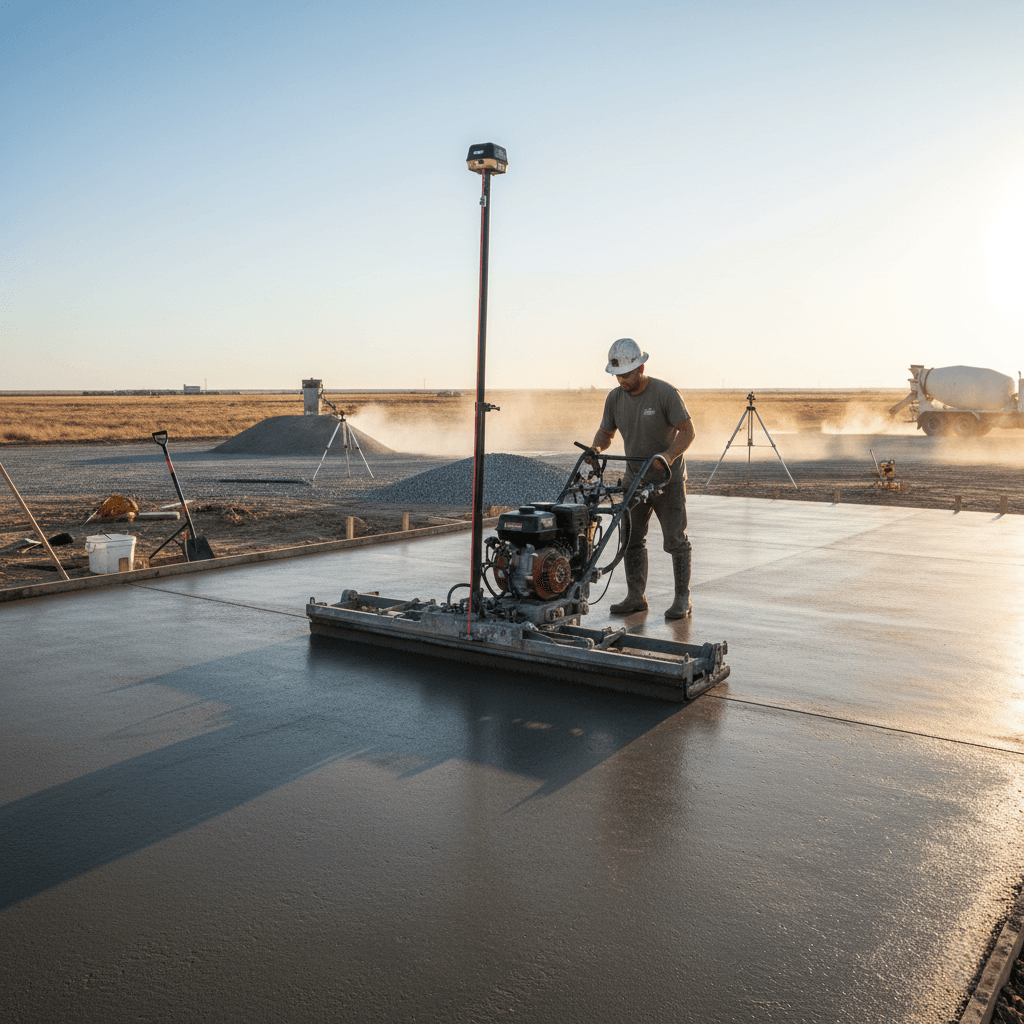
Laser-Guided Advanced Screeding Technology
The construction industry has made significant advancements in technology and tool usage in recent years. One of the largest advancements has been the introduction of laser-guided advanced screeding technology for concrete flatwork installation projects in the Permian Basin region. Laser-guided advanced screeding technology provides unparalleled accuracy in comparison to manual screeding methods. It also eliminates human error that can occur during large-scale flatwork projects. These tools enable contractors to achieve consistency in elevation over large areas, such as warehouse floors and commercial parking lots.
Laser Leveling Systems
State-of-the-art leveling systems have greatly improved contractors’ ability to perform precise measurements and make necessary adjustments in their work. These technologies have provided contractors with unprecedented levels of precision in achieving flat surfaces that meet all specifications for projects within the Midland area. Rotating laser levels are used extensively to establish reference points on job sites and maintain a consistent elevation, even under adverse wind conditions. In addition to the increased accuracy provided by these technologies, they allow for faster completion of projects and greater productivity for contractors.
Screeding Methods
While traditional screeding methods are still important for small residential projects located in neighborhoods surrounding the George H.W. Bush Childhood Home, many contractors still use this method today. Manual screeding involves leveling the wet concrete with a screed board. Once screeding is complete, the contractor will begin the finishing phase of the project. During this phase, the contractor uses various tools, such as trowels, edgers, and groovers, to create a smooth and uniform surface. Many contractors modify their screeding techniques to accommodate the rapid surface drying properties found in Midland.
Climate-Specific Obstacles in Midland
As mentioned earlier, Midland has a desert climate, which creates several unique challenges for contractors performing concrete flatwork installations. Due to the climate, contractors need to take extra precautions to achieve the best possible results. In the late winter and early spring months, the blowing dust caused by the winds makes it difficult for contractors to place fresh concrete without contaminating the surface.
Windscreen and Dust-Suppression Techniques
Contractors working in the vicinity of the Commemorative Air Force Museum have begun implementing windscreens and dust-suppression systems during concrete placement. To minimize exposure to the harsh elements, contractors often schedule their placements at times other than peak wind hours. Peak wind hours are generally during the late winter and early spring months, when dust storms may reduce visibility to 1-3 miles.
Temperature Factors
Midland has long, hot, and mostly clear summers, and short, cold, dry, windy, and partially cloudy winters. Over the course of the year, the average temperature in Midland ranges from 34°F to 95°F and is rarely less than 23°F or greater than 102°F. These extreme fluctuations in temperature require contractors to carefully time their placements and use special curing techniques to avoid thermal cracking and promote proper hydration.
Methods for Maintaining Moisture Levels
Due to the rapid evaporation rate in the arid climate of Midland, contractors must aggressively retain moisture during the concrete placement and curing process. Contractors utilize numerous methods to ensure there is sufficient moisture present on the surface of the concrete throughout the early stages of curing.
Retarding Evaporation
Chemicals known as evaporation retarders that are applied directly to the surface of the concrete immediately after screeding help preserve the surface moisture during the initial setting period. These chemicals are extremely beneficial for contractors installing large amounts of flatwork in the Midland area, due to the potential for excessive evaporation over an extended placement time.
Creating Moisture Barriers
There are numerous curing compounds available that provide a moisture barrier that prevents excessive water loss from the concrete surface. The timing of the application is critical in Midland’s windy environment because it is essential to apply the compound immediately after completing the final finishing operations.
Concrete Leveling Using Polyurethane Foam
Modern concrete leveling goes beyond just the placement of the original concrete slab. It addresses settling problems commonly associated with the expansive clay soils found in Midland. At Lift-Texas Construction, we specialize in providing professional concrete leveling services utilizing the latest technology with polyurethane foam. Our experienced staff provides high-quality solutions to clients experiencing uneven or unstable concrete slabs by strategically drilling holes into the affected area and injecting the foam underneath.
Comparison of Mudjacking and Polyjacking
Both mudjacking and polyjacking have been successful methods in addressing settled flatwork in the Midland area. However, the type of soil and moisture levels in the area make one method more desirable than the other. With so much experience in dealing with both types of materials, G.L. Hunt’s experienced staff will be able to determine the best approach for your particular situation and provide you with a stable and level surface to support the Texas weather.
Ensuring Quality Under Adverse Conditions
Maintaining quality standards while operating in Midland’s harsh environment requires continuous monitoring of environmental conditions and adaptable techniques. Contractors continually check the weather and adjust their procedures accordingly to maximize results regardless of environmental conditions.
Measuring Surface Elevation
Electronic levels and straightedges are used by contractors to measure the elevation of the concrete surface prior to the first set of concrete, to ensure that the surface is level and meets the specified tolerance for the project. Several contractors working on projects adjacent to the Wagner Noël Performing Arts Center use precision measuring instruments to verify the surface elevation accuracy.
Documenting Placement Procedures and Environmental Conditions
Throughout the placement procedure, contractors document a variety of data, including the environmental conditions, mix adjustments, and placement procedures. Documentation of this nature is useful for warranty purposes and can help improve contractor techniques for future placements in similar environments.
Expert Experience to Achieve Best Possible Results
To achieve excellent results when placing concrete flatwork in the harsh Midland climate, a contractor should possess knowledge of the local climate and the most effective techniques to accomplish the task. Our company brings together years of experience in the West Texas area and state-of-the-art equipment to produce consistently exceptional results in the Permian Basin area. We adapt our techniques to accommodate the unique characteristics of the Midland climate while maintaining the highest quality standards for residential, commercial, and industrial applications. By paying close attention to climate-related aspects, selecting the correct tools, and utilizing proven techniques, we ensure that concrete flatwork installations remain level and durable for decades. As a result of years of experience and success working in the West Texas climate, the expert knowledge available through Midland Concrete Services is the culmination of years of experience working successfully in the region.
LATEST POSTS